
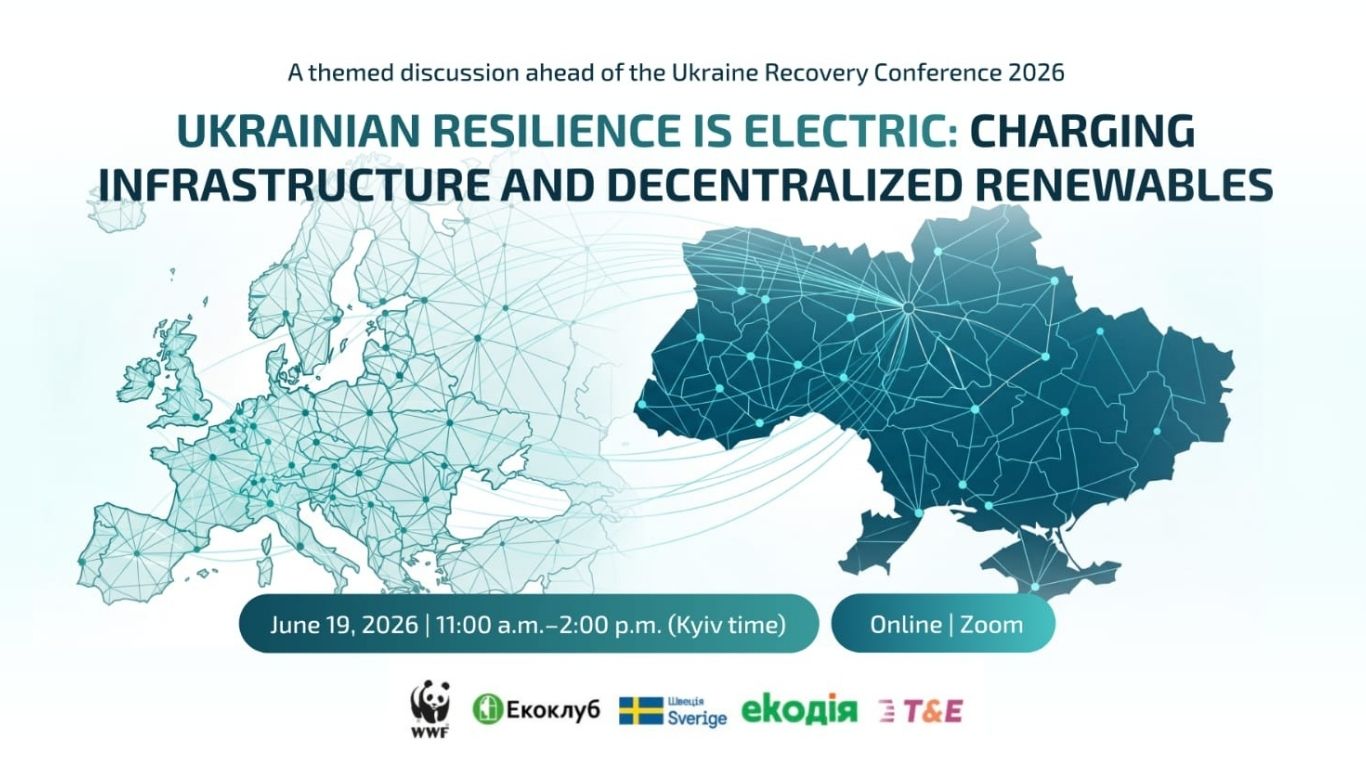
Ukraine’s reconstruction creates a unique opportunity to modernize energy, transport, and building infrastructure in an integrated way. The rapid growth of the Ukrainian battery electric vehicle market, charging infrastructure, and renewable energy sources since 2022, coupled with recurrent grid disruptions caused by Russia’s attacks and the need to align with EU legislation, all point to the same priority: Ukraine needs decentralized, renewable, and resilient energy solutions.
To explore the development of the electric vehicle (EV) market, and the expansion of charging infrastructure during wartime, and the implementation of the European AFIR (Alternative Fuels Infrastructure Regulation). Ecoaction, Ecoclub, and Transport and Environment organized a large-scale panel discussion. The event included representatives from the Ukrainian government, the European Commission, the EBRD, the National Energy and Utilities Regulatory Commission, and industry associations.
The full recording of the event is available on our YouTube-channel
Ecoaction and T&E presented their research on the AFIR and EPBD Directives and the current stage for Ukraine as follows. Despite differences in the scope of the documents (AFIR addresses charging infrastructure outside cities, while EPBD defines it in cities), the key barriers to overcome are similar. These include the harmonization of legislation and terminology, the need for technological development, and the formation of transparent procedures. Details of the studies can be found at the links: AFIR, EPBD.
A representative from the Ministry for Communities, Territories and Infrastructure Development announced that Ukraine is actively preparing to integrate into the European transport network. In early 2027, a package of laws is planned to be submitted to the Ukrainian Parliament to officially implement the European AFIR framework, with a focus on electric vehicles.
Developing large-scale projects, however, requires international support. Representatives of the European Commission and the EBRD emphasized that early-stage charging infrastructure projects typically have negative cash flows and are commercially challenging to fund via senior debt. Therefore, they critically depend on donor financing, budget guarantees, and grants that cover investor risks.
As noted by Vadym Ihnatov, Deputy Head of the Ukrainian Association of EV Market Participants, the industry is currently experiencing a sharp downturn. He called this situation a “perfect storm” caused by three concurrent factors: the reinstatement of VAT on EVs, constant attacks on energy infrastructure leading to electricity supply disruptions, and a rapid increase in electricity costs.
The most heated discussion centered around electricity market regulation. Oleg Kostrikin, a director at NEURC, stressed the importance of moving to dynamic tariffs. During periods of excess solar generation, electricity prices can drop to 0,1 UAH per kWh (0,2 Eurocents) or even go negative, yet fast-charging operators fail to take advantage of this opportunity, artificially keeping prices at around 22 UAH (43 Eurocents) per kWh.
At the same time, the development of commercial infrastructure is heavily blocked by the existence of Public Service Obligations, which subsidize electricity prices for households, dropping them to as low as 2.16 UAH (4.2 Eurocents) at night. According to NEURC, the state does not consider it appropriate to subsidize the charging of private EVs through condominiums (OSBBs) at this preferential rate, as these funds are intended exclusively for basic life support. Furthermore, current rules mandate that electricity billed to an apartment must be consumed inside it, making “charging from a window” officially impermissible.
Tetiana Boiko, a program coordinator at the OPORA Civic Network, strongly supported the need for a complete transition to a free electricity market. She argued that abolishing the PSO is the only systemic step that will balance the market, attract investment, and resolve the ongoing legal conflicts surrounding EV charging at apartment buildings.
The discussions underscore three key needs: establishing reliable statistical data, transitioning to a free-market model to stimulate commercial investment, and integrating electromobility and home-charging concepts into new building standards.