
We’re Nine Years Old!
Ecoaction’s Victories in April 2025 — March 2026
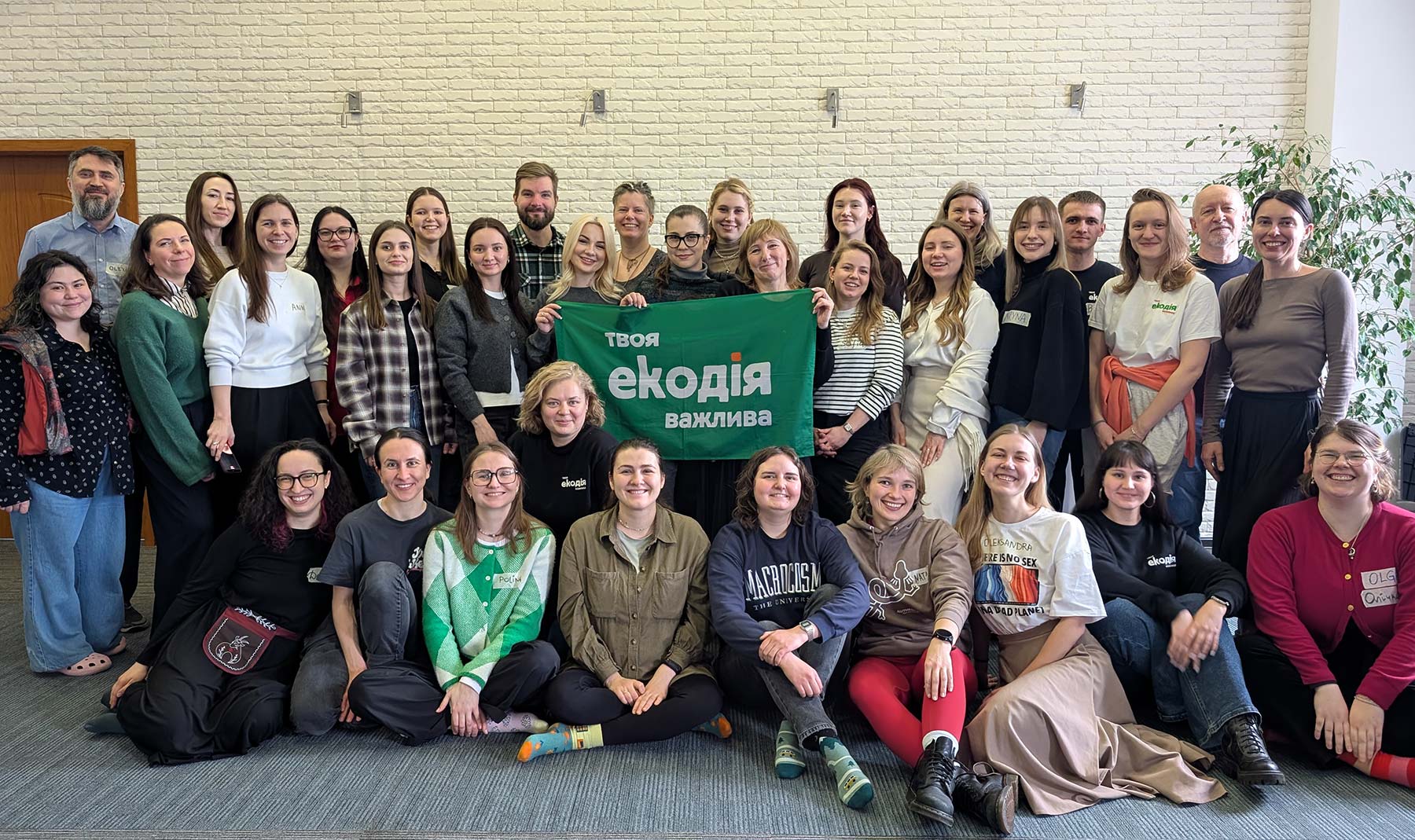
On 13 March, Ecoaction turns nine. Despite a full-scale war, constant uncertainty, and new challenges, we continue to work towards an environmentally safe future for Ukraine. We have advocated for important reforms, supported communities in implementing sustainable solutions, researched the impact of the war on the environment, and amplified the voice of Ukrainian activists internationally. At the same time, Ecoaction has continued to grow as a community. Together with volunteers, Friends, and members of the organisation, we have written appeals, signed petitions, and spread knowledge about environmental protection in Ukraine and abroad. It is thanks to our joint efforts that we have much to be proud of — and we are pleased to share Ecoaction’s main victories over the past year.
What was the work of the Department of Agriculture and Land Use in 2025
We are proud that we managed to:
- Create an interactive map of nitrate pollution in groundwater across Ukraine;
- Conduct a survey of Ukrainian farmers’ views on EU environmental policy, with a focus on water and biodiversity;
- Facilitate an exchange of experience between Ukrainian and Polish stakeholders on existing practices to reduce nitrate pollution of water from agricultural sources;
- Begin work on a calculator for manure generation and storage conditions in dairy farming;
- Conduct a social survey of communities on their attitudes towards nature reserve fund sites and, based on this, prepare a manual outlining the benefits of creating protected areas for communities;
- Support five local projects aimed at preserving biodiversity;
- Participate in the preparation of an analytical report on large-scale land acquisitions for carbon offset projects, produced by the international initiative Land Matrix;
- Carry out a number of expeditions, including to the Runa Valley in the Ukrainian Carpathians, where a construction of an illegal wind farm is attempted, and, together with Bankwatch, to wind farms in Volyn and Skolivska Wind Farm (Lviv region) to investigate the situation surrounding planned and existing projects;
- Contribute to the publication of the results of an international review concerning rural communities in the Ivano-Frankivsk region affected by Goodvalley’s industrial pig farms (formerly Danosha, Axzon). After a record 11 years of reviewing the complaint, the international office of the Compliance Advisor/Ombudsman (CAO) published a critical report confirming the failure of the International Finance Corporation (IFC) to comply with some of its own social and environmental requirements when lending to the company;
- Assist in investigation of complaints from local residents regarding the impact of the MHP industrial poultry farm in the Vinnytsia region. This case involves two international accountability mechanisms simultaneously: the IPAM (EBRD Complaints Mechanism) investigation report is expected to be published soon and raises a number of systemic issues requiring attention; in parallel, the CAO has completed a preliminary assessment of IFC compliance with its social and environmental policies, launched a formal investigation, and plans to publish its final report in 2026, after which a management action plan from the banks is expected;
- Analyse EBRD projects in the district heating sector, focusing on the sustainability of biomass technologies;
- Analyse European Investment Bank (EIB) public transport projects, identifying inconsistencies between the bank’s climate goals and its continued financing of diesel buses, as well as highlighting lengthy and complex procedures for financing municipal projects;
- Prepare an analysis of the Single Project Pipeline (SPP) for 2025, a new tool for managing public investment. The report was published and shared with decision-makers, and its key conclusions, caveats, and recommendations were presented to representatives of EU senior management, diplomatic missions, international financial institutions, and the European Commission’s Directorate-General for Enlargement and Eastern Neighbourhood (DG ENEST).
How was it?
For the Department of Agriculture and Land Use, 2025 was a year of progress in implementing the Nitrates Directive, while also being a turbulent period that required flexibility in our approaches. Changes in the structure of central executive bodies, including the dissolution of the specialised Ministries of Environmental Protection and Natural Resources and of Agrarian Policy and Food, and the creation of a unified Ministry of Economy, Environment and Agriculture of Ukraine, significantly complicated the maintenance of established relationships and procedures that had enabled public organisations to cooperate directly with ministries.
While the merger of specialised state bodies could address the issue of divided responsibilities, the restructuring process and associated personnel changes created new challenges, causing some processes to be delayed or deprioritised. Despite this, we continued our systematic work across all areas.
For nearly ten years, Ecoaction has advocated for the adoption of the EU Nitrates Directive, one of the most important instruments for preventing and reducing water pollution from agricultural activities. This year, we sought new ways to advance this goal: we engaged the Ecoaction community in signing appeals and communicating with the relevant committee. As in previous years, we also conducted expeditions to communities affected by nitrate water pollution to demonstrate the scale of the problem.
Despite the long-standing nature of this struggle for clean and safe water, we are not giving up.

At the same time, we supported five environmental projects across different regions of Ukraine and conducted a large-scale sociological survey of communities regarding their attitudes towards nature reserve fund sites. Based on this, we prepared a manual highlighting the benefits of establishing protected areas for communities. This work represents an important step towards dispelling misconceptions about such sites and fostering motivation to preserve Ukraine’s natural heritage.
A separate strand of our work involved participation in the international Land Matrix initiative. We analysed land use for wind farms across different regions of Ukraine, examining the transparency of processes, as well as the impacts on local communities and ecosystems. This enabled us to approach “green” energy in a comprehensive way — not only as the future of Ukraine’s energy system, but also as an area where clear rules, community participation, and a balance of interests are essential.
This year has demonstrated that even amid the weakening of relevant state institutions, the systematic work of civil society can keep environmental issues on the national agenda. Ecoaction will continue to advocate and work diligently to ensure a clean and healthy environment for future generations, regardless of political or economic transformations.
What has the Energy Department achieved in Ecoaction’s ninth year?
Thanks to our work:
- The Government adopted the State Target Programme for the Just Transition of Ukraine’s Coal Regions until 2030, a process in which Ecoaction has been involved for years through advocacy, communication, and expert input;Coal Regions until 2030, a process in which Ecoaction has been involved for years through advocacy, communication, and expert input;
- The concept of just transition was expanded beyond coal regions to include communities dependent on the oil and gas and metallurgical industries. Ecoaction brought together 40 local authorities and elevated their shared challenges to the national level during the annual Forum;
- In the State Budget of Ukraine for 2025, more than UAH 240 million was allocated to the Energy Efficiency Fund, while over UAH 620 million has been allocated in the 2026 budget;
- Ukraine launched the Energy Efficiency Map of Residential Buildings, which allows users to assess the comfort and cost-effectiveness of living in different buildings even before buying or renting them. The map was developed by Ecoaction in cooperation with LUN Misto;
- The plans of the Ministry of Community and Territorial Development for 2026 incorporated Ecoaction’s proposals to introduce a system for displaying energy efficiency classes in building advertisements and to improve the integration and accessibility of registers for online marketplaces;
- The results of Ecoaction’s research on how to stimulate thermal modernisation of buildings without homeowners associations will be used in cooperation with the Ministry of Development and the Energy Efficiency Fund when designing support programmes for such buildings; associations will be used in cooperation with the Ministry of Development and the Energy Efficiency Fund when designing support programmes for such buildings;
- The requirement that energy communities must be exclusively non-profit was removed from the draft law “On Amendments to Certain Laws of Ukraine on the Implementation of EU Legislation in the Field of Renewable Energy”, which would otherwise have hindered their development in Ukraine;
- The draft law on completing Units 3 and 4 of the Khmelnytskyi Nuclear Power Plant was not brought to a vote in the Verkhovna Rada, a result also supported by Ecoaction’s long-term advocacy and cooperation with anti-corruption organisations;
- Ecoaction’s sociological research showed that 68% of Ukrainians oppose the completion of the Khmelnytskyi NPP during the war;
- Ecoaction’s proposals were included in the draft National Energy and Climate Plan (NECP), including measures to protect decommissioning funds for nuclear power plants from inflation and to expand just transition to mono-industrial and carbon-intensive regions;
- The Energy Department’s key topics were presented at 19 events organised by Ecoaction. In particular, the “From the Bottom Up 2.0” camp brought together nearly 50 activists from across Ukraine for five days of training on implementing effective changes in their communities, as well as exploring energy issues and the future of Ukraine’s reconstruction.
How was it?

The year 2025 marked the culmination of many years of work for the Energy Department. Efforts that began in 2018 on just transition, and more recent work on energy communities, have now started to deliver systemic results. We not only maintained our activities but significantly scaled them up, expanding both the scope of our work and our capacity to engage with an increasing range of topics.
At the same time, the year required maximum flexibility and rapid responses to political developments in Ukraine. In particular, we had to act swiftly when renewed attempts were made to push forward decisions on constructing new units at the Khmelnytskyi Nuclear Power Plant. Through timely advocacy, public engagement, and cooperation with anti-corruption organisations and members of parliament, these decisions were halted, and the procurement of equipment of Russian origin was prevented.
We also adapted our approach to working with communities. While initially we supported them in drafting municipal energy plans, our focus has now shifted towards training. Our aim is to enable communities to independently develop these documents and implement energy projects.
A major achievement was our progress in advancing the topic of just transition. The Ukrainian government has finally adopted the State Target Programme until 2030, an initiative to which Ecoaction has contributed for years through advocacy and expert input. At the same time, we expanded our work in this area: we now support not only coal regions but also other carbon-intensive and mono-industrial communities in navigating just transition processes. Over the past year, we increased the number of partner communities from 20 to 40.
We also strengthened our work on energy efficiency, engaging both with homeowners associations (HOAs) and continuing research on implementing energy efficiency measures in apartment buildings without HOAs. Cooperation with LUN Misto was particularly significant, resulting in the availability of open and accessible data on the energy efficiency classes of buildings.
In parallel, Ecoaction organised the second annual “From the Bottom Up” camp, where activists gained practical knowledge on creating environmental initiatives and achieving tangible change.
This year has demonstrated that consistent, long-term efforts yield results. Building on the experience gained, Ecoaction will continue working towards a sustainable and safe energy system for Ukraine, as well as warm and energy-efficient homes for its people.
How did the Climate Department end the year?
Despite the challenges, we managed to:
- Strengthen the capacity of climate experts to engage with the media by organising the Ecoaction Climate Media School;
- Support the implementation of 12 events aimed at raising awareness of climate change as part of the online marathon, held to mark the 25th anniversary of the Ukrainian Climate Network;
- Together with the Initiative for Accounting for Greenhouse Gas Emissions from War, ensure that in November 2025, at the COP30 climate conference, Ukraine announced its intention to submit a claim to the international Register of Damage for Ukraine to seek compensation for climate damage caused by Russian aggression;
- Prepare a position paper on climate policy priorities for COP30, contribute to giving the Fossil of the Day “award” to the Russian Federation at COP30, and bring the issue of climate damage caused by Russian aggression to international attention;
- Provide expert and communication support to the Greenpeace Ukraine campaign on the High Seas Treaty , which Ukraine signed in August 2025; the next step is its ratification by the Parliament of Ukraine;
- Prepare Ecoaction’s position paper on the introduction of a greenhouse gas emissions trading system (ETS), as well as a position paper on carbon credits in voluntary markets, both of which were supported by an association of 40 environmental organisations;
- Participate in the first Ukrainian Climate Week — a series of events and activities dedicated to climate change and aimed at consolidating efforts to address it;
- Submit Ecoaction’s accepted proposals to the draft Nationally Determined Contribution (NDC) by 2035, emphasising the importance of climate change adaptation and the need for a just transition;
- Together with partners, organise a series of events in Kyiv as part of the European Mobility Week, drawing attention to the importance of sustainable urban mobility;
- Prepare recommendations for the Ministry for Development of Communities and Territories of Ukraine on public transport reform and tolling;
- Participate in the development of the Roadmap for the Sustainable Recovery of Ukraine;
- Together with Cedos, conduct a needs assessment of 12 urban communities participating in the SUN4Ukraine project, focusing on pathways towards climate neutrality under conditions of full-scale invasion; these findings formed the basis for subsequent project activities;
- Facilitate city partnerships — Kharkiv–Izmir and Novovolynsk–Aachen — within the Partnership Programme of the SUN4Ukraine project, linking Ukrainian communities with cities participating in the EU Mission for Climate-Neutral and Smart Cities. The aim is to accelerate climate neutrality planning through knowledge exchange and alignment with the EU Mission’s ambitious goals.
How was it?
For the Climate Department, the past year was a period of qualitative growth and the transformation of long-standing experience into systemic solutions. We not only continued developing our existing areas of work, but also significantly strengthened the team’s expertise within an expanded structure. Our capacity to influence climate policy has increased, enabling us to address a broader range of topics — from carbon pricing to community-level climate adaptation.
We continued our work on documenting and calculating climate damage caused by the war, the results of which are published annually in dedicated reports. Our persistence contributed to Ukraine’s official announcement at COP30 of its intention to submit these data to the international Register of Damage for Ukraine. This represents an important step towards securing compensation for climate damage caused by Russia.
Ecoaction supports the implementation of a transparent, fair, and environmentally effective emissions trading system in Ukraine. Accordingly, we intensified our work on carbon markets and began exploring the role of carbon credits as a pricing tool — both to prevent greenwashing practices and to ensure genuine emission reductions rather than reductions “on paper”. This work is essential to ensure that those responsible for climate damage are held accountable.
Work with communities remained a key priority, both within the SUN4Ukraine project and in the broader context of climate change adaptation. Major achievements this year included building trust with participating cities, as well as launching a capacity building component and a partnership program; through the latter we facilitate cooperation between Kharkiv–Izmir and Novovolynsk–Aachen.
In 2025, participating communities moved directly into planning for climate neutrality. Their experience as pioneers will later be extended to other communities across Ukraine, including through the Ukrainian Cities Climate Hub.
In addition, we fully relaunched our work on sustainable urban mobility, establishing an effective network for cooperation between civil society organisations and the relevant ministry.
At the same time, together with the Ecoaction volunteer team, we continued to develop and visualise an interactive map of potential environmental damage caused by Russian aggression, helping to demonstrate the international community the scale and consequences of this destruction.
What did the Communications Department work on in 2025?
Key results of our work:
- We strengthened our offline community in Kyiv and met with our volunteer team, Friends, and Ecoaction members almost every month;
- Together with 2,250 festival visitors in Kyiv, we created a collaborative colouring map illustrating environmental problems and solutions, helping to raise awareness of pressing environmental issues. Our volunteers supported this effort by exploring more than 12 topics addressed by the organisation and sharing this knowledge with participants;
- In total, 80 volunteers supported our work, contributing to various activities more than 300 times;
- In August 2025, we marked the third anniversary of the volunteer team that monitors cases of potential environmental damage caused by the war;
- We organised the “Znyzu vverkh” (“From the Bottom Up”) camp;
- We created a large-scale climate comix, “Deadlines Are Burning”;
- We contributed to over 1,000 mentions of environmental issues in Ukrainian and international media;
- Hundreds of thousands of social media users saw and engaged with our posts on key issues, such as the construction of a wind farm in the Runa Valley and the expansion of the Kharkiv highway;
- More than 45 new Friends joined Ecoaction, providing financial support for our work.
How was it?
For the Communications Department, 2025 was a period of expanding our audience and strengthening Ecoaction’s role in public discussions on environmental issues. We worked to make complex topics more accessible to a broader audience — from local communities to national media. At the same time, we actively supported communication across all areas of the organisation’s work, helping to translate expert research and advocacy campaigns into stories that resonate with Ukrainian society.
Together with our Community, we advocated for the implementation of the Nitrates Directive in Ukraine, submitted comments on the draft Nationally Determined Contribution (NDC) for 2035, called for the adoption of the High Seas Agreement, distributed informational materials on the dangers of burning dry plant residues, and supported a petition against the legalisation of land grabbing. These collective actions not only demonstrate to Ukrainian authorities that citizens care about a clean and healthy environment, but also serve as a catalyst for real change.
We also placed strong emphasis on building and strengthening our offline community in Kyiv. Almost every month, we brought together volunteers, Friends, and Ecoaction members to learn, exchange experiences, and take action. Activities included participating in an owl census in Holosiivskyi National Nature Park, learning creative approaches to street advocacy, discussing Ecoaction’s comix “Deadlines Are Burning” in a bookshop setting, and upcycling clothes with bloc printing technique.
Together with the Community, we explored how to use platforms provided by the Ukrhydrometeorological Institute, learned practical approaches to creating biodiversity-friendly spaces, discussed EU institutional structures, and walked along the ecological and educational trail “Forest and Climate” in Holosiivskyi Park.
One of the key achievements of the year was a significant increase in our social media reach. Some posts extended far beyond our usual audience: for example, content highlighting the risks associated with the proposed wind farm in the Runa Valley gained hundreds of thousands of views and helped draw attention to issues of construction without proper documentation and approvals. This demonstrates that environmental topics, once confined largely to expert circles, are increasingly entering the broader public agenda.
We are proud that Ecoaction and its experts are becoming more visible in the media. Over the course of the year, we appeared 25 times on radio and television — including live broadcasts, expert contributions, and commentary — addressing climate policy, the environmental impacts of war, energy, sustainable agriculture, and the Nitrates Directive.
We also contributed to a podcast on ecocide, discussing how war affects the climate, destroys natural ecosystems, and why this is a matter of international responsibility. In addition, one of Ukraine’s leading media outlets, NV, published our column examining how Russia promotes its narratives through climate reporting at the United Nations, highlighting the mechanisms behind such manipulation and the importance of recognising it.
Despite the challenges of full-scale war, instability, and uncertainty about the future, the Ecoaction Communications Department responded quickly to emerging environmental challenges, legislative initiatives, and public debates, often adapting plans and priorities in real time. This flexibility is one of our key strengths, supported by the daily dedication of people who continue their work even under difficult conditions.
Reporting on finances
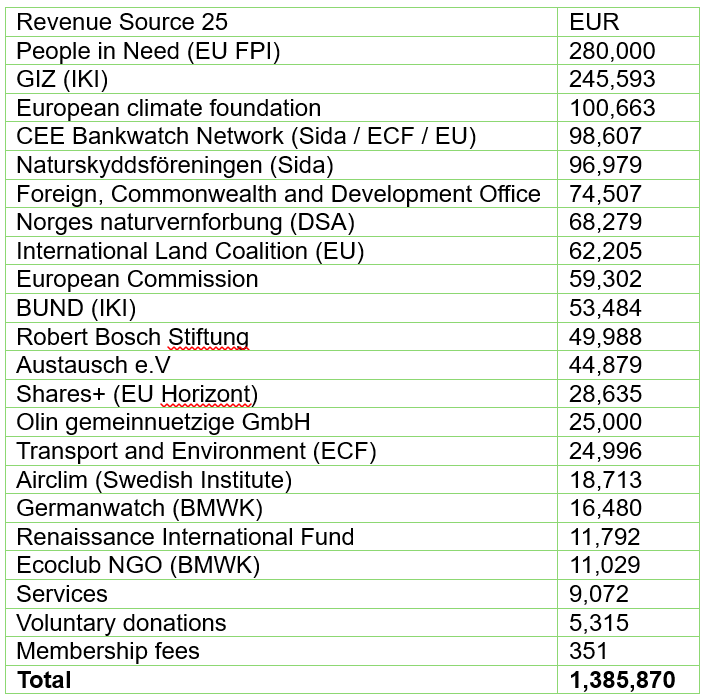
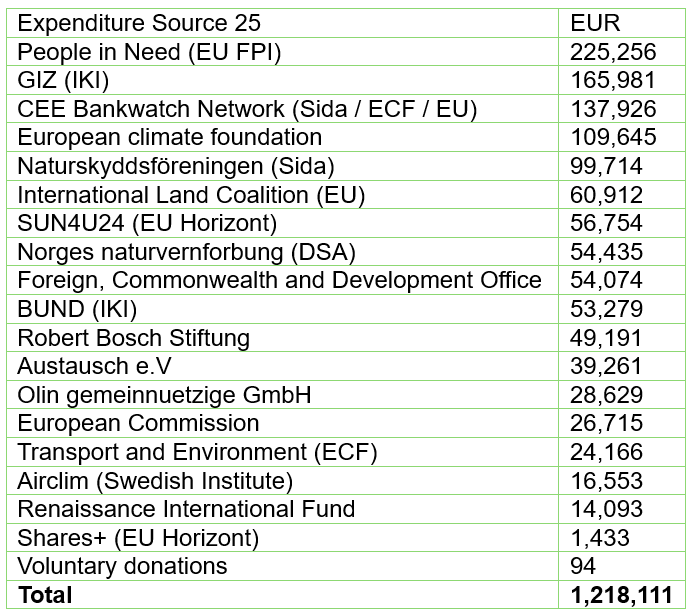
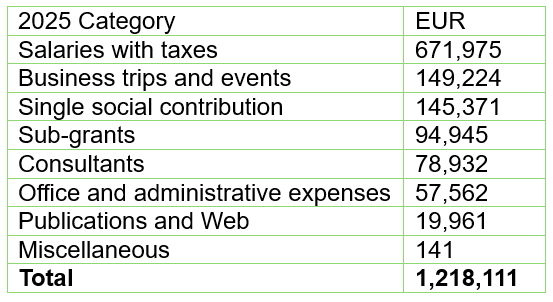
Transparency is fundamental to the work of a public organisation. Above, we have openly shared the most important aspects of our work over the past year. Below, we present information on the funding we received and how these resources were allocated.
Revenue 2025 (EUR)
Expenditure 2025 (EUR)
Our work would not be possible without those who support us through their financial contributions. We are sincerely grateful to our donors and partners for their continued support.
We also extend special thanks to the engaged and active citizens who contribute to Ecoaction’s work — our Friends and members. Thank you for being with us.
Want to help change the world for the better but do not always have the time? Support Ecoaction financially.