
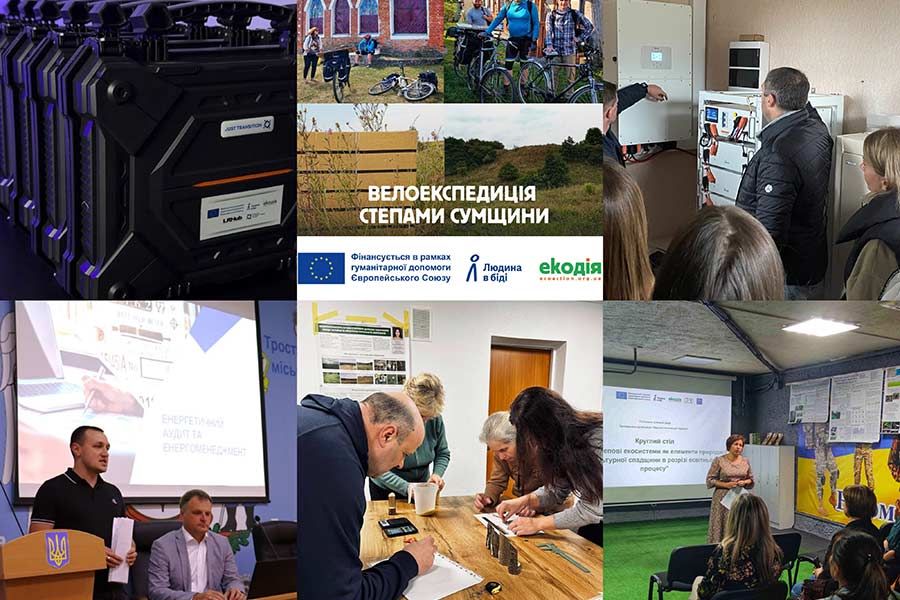
In 2025, three local initiatives in renewable energy and energy efficiency in the Sumy and Dnipropetrovsk regions received financial support from the European Union through the Czech humanitarian organization People in Need Ukraine, in partnership with the Ecoaction. These frontline regions regularly suffer from Russian attacks and therefore have an acute need for support not only to strengthen their energy independence but also to preserve local nature. Below, we describe what the grant-winning organizations were able to achieve through their projects.
Strengthening the energy competence of the Trostianets community
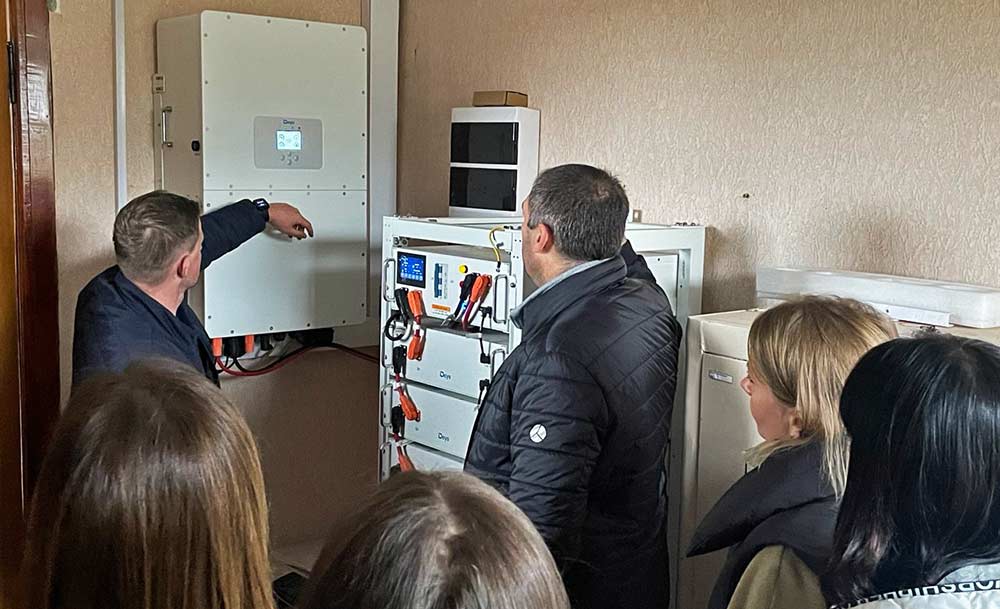
The NGO Center for European Integration of Slobozhanshchyna helped the Trostianets community improve its skills in effective energy management. Over six months, representatives of local authorities and public institutions participated in three training sessions on the principles of energy management, energy audits, the development of technical specifications for implementing energy efficiency and renewable energy projects, as well as opportunities for financing such initiatives. A hands-on session featuring a demonstration of solar power plants was held directly at the Trostianets City Council.
In addition, five energy audits in buildings of local educational institutions – three lyceums and two of their branches – were conducted within the project so that community representatives could identify the main sources of energy losses and understand the potential for improving energy efficiency. Based on these findings, the Center for European Integration of Slobozhanshchyna, together with the Trostianets City Council, plans to implement the measures identified by the audits.

Capacity-building for coal-mining communities in Dnipropetrovsk region
The LRHub Center for Economic Growth, in partnership with the Association of Coal Communities, also focused on strengthening the energy competence of communities. Energy audits of key municipal facilities were conducted in seven communities, revealing a potential 15-20% reduction in energy consumption. Six communities also received “energy manager kits” – sets of essential equipment for conducting audits and inspections.
For the Zelenodolsk, Shakhtarsk, and Mykolaiv communities, more detailed documentation was prepared, including preliminary feasibility studies for specific projects: the modernization of a hospital heat substation, modernization of the lighting system in a lyceum, and installing a solar power plant at a kindergarten. This documentation outlines the technical solutions for each facility and includes key indicators such as investment size, annual energy savings, and payback period – basic parameters required for subsequent project design and cost estimation, which will help draw necessary funding.
Educational activities were also conducted for each community. Meetings were organized for local government officials to explain the purpose of energy audits and how to use the energy manager kits.
Separate awareness-raising events were held in community schools. Interactive sessions for students aged 12-17 covered topics such as energy efficiency, rational energy use, and the role of renewable energy sources. Students learned how simple daily actions, from turning off the lights to using appliances responsibly, can help reduce energy consumption and environmental impact.
Using phytomass in energy production to preserve steppes in the Sumy region
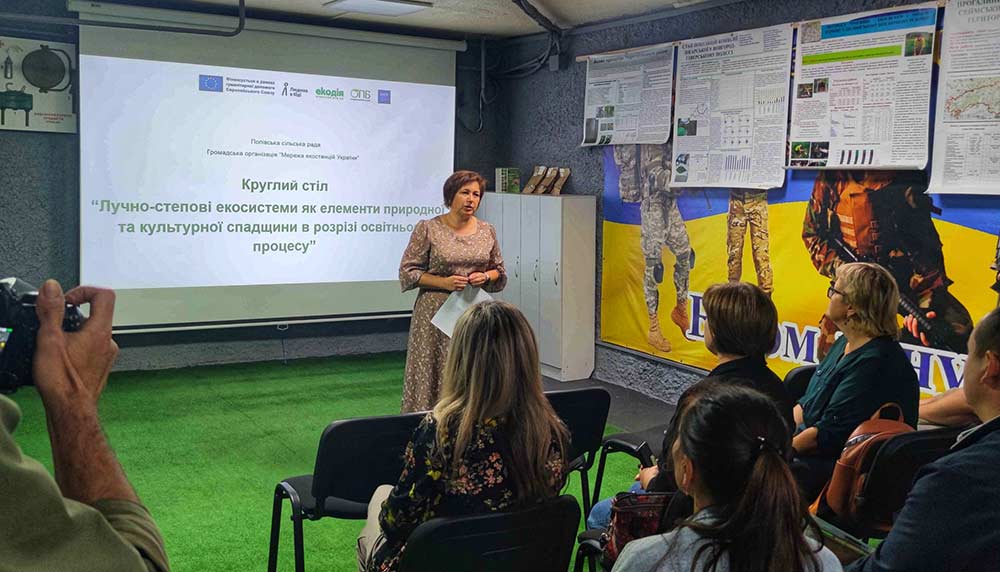
The Network of Ecostations of Ukraine (NEU) and the Practical Botany Island focus on preserving the region’s meadow-steppe areas. As part of their project, NEU explored the possibility of using excess phytomass (i.e., mown vegetation) as a raw material, including for energy production.
The project involved purchasing equipment and setting up a technological process for grinding hay collected from a restored steppe meadow. During implementation, it became clear that the technical capacity to produce fuel pellets was currently limited, so the grass meal was instead used to produce a pilot batch of feed pellets. However, the experience gained will support NEU in further exploring technical solutions for using phytomass in energy production.
The project also included conservation and educational activities. A botanical cycling expedition was held along the Saranivka route to the field of the Battle of Konotop, Romny, marmot colonies in Pisky and Hlynsk, the Oksiutyn Mounds, and other areas. Together with local teachers and students, participants assessed the biodiversity and productivity of meadow-steppe ecosystems.
During the expeditions, 20 sites were examined, species lists were compiled, major threats to the region’s steppe meadows were identified, key habitats were documented, and field materials were collected, which were later used to prepare educational resources.