
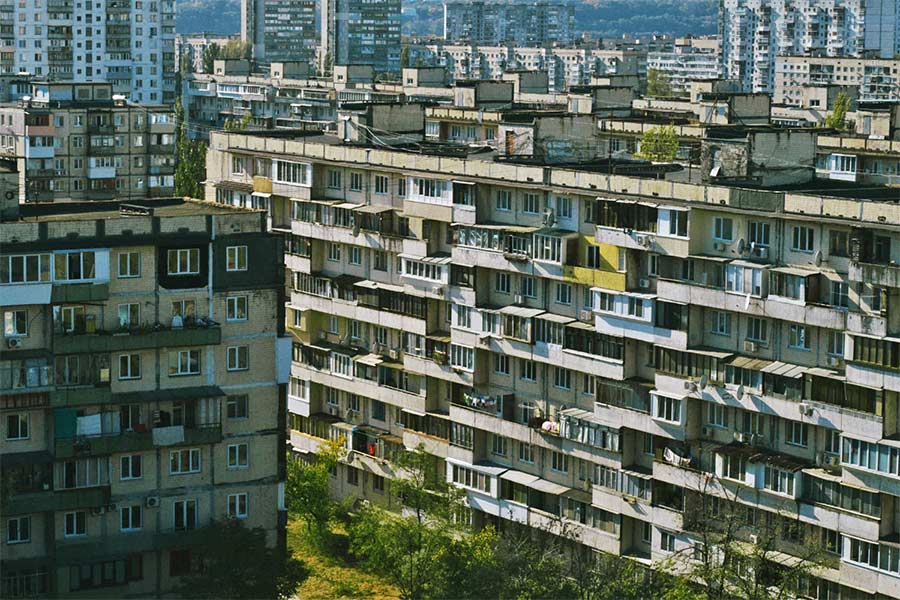
More than 80% of multi-apartment residential buildings in Ukraine do not have homeowners’ associations (HOAs) and, as a result, are effectively unable to access state or local thermal modernisation programmes. This is highlighted in the findings of a study by the NGO Ecoaction, which analyses the current condition of such buildings and the barriers to modernising housing stock without homeowners’ associations.
According to the study, national support programmes such as Enerhodim, GreenDIM, and VidnovyDIM, as well as banking instruments including leasing and concessional lending, are exclusively targeted at homeowners’ associations (HOAs), housing cooperatives, and similar collective entities. Buildings without HOAs are not eligible to apply for these programmes, even in cases where an initiative group is present. Only a limited number of municipalities offer local co-financing mechanisms or revolving funds; however, these remain isolated and non-systemic in nature.
According to a survey conducted by the Kyiv International Institute of Sociology (KIIS), 91% of residents express a willingness to implement energy efficiency measures, 74% are not aware of any programmes they could use, and 48% indicate readiness to establish a homeowners’ association (HOA). However, they cite the passivity of their neighbors and the complexity of organising the processes as the main barriers.
“In recent years, Ukraine has been modernising only those buildings that already have homeowners’ associations (HOAs). Yet the greatest heat losses occur precisely in buildings whose residents lack access to funding programmes for energy efficiency measures. Changing this situation requires not only residents’ willingness but also systemic government action. The government must provide tangible support — from financial incentives to advisory services — and create conditions that simplify the organisation of co-owners. Without this, the majority of buildings will remain excluded from modernisation programmes, and the country will miss the opportunity to reduce energy-related risks,” notes Iryna Klymas, energy policy specialist at Ecoaction.
Gaps in government policy pose a separate problem. The study points to weak oversight of management companies, insufficient transparency in their work, and a lack of accessible advisory services and technical support at the community level. Furthermore, Ukraine still lacks a structure that would be systematically responsible for managing the housing stock. Functions in this area are distributed among several executive authorities, in particular the Ministry of Development, which handles housing and communal services, and local authorities.
Even in buildings without homeowners’ associations (HOAs), minimal energy efficiency measures can still be implemented, such as installing building-wide meters, balancing heating systems, insulating pipes, and installing individual heating units. According to experts, modernisation can reduce the energy consumption of buildings by approximately 42%. For residents, this translates into lower utility bills and an extended lifespan of the building itself.
However, without financial instruments and technical support, energy efficiency solutions remain inaccessible for most older buildings. Therefore, experts urge the government to provide a minimum mandatory package of measures for these buildings, ensuring quick results, resource savings, and motivation for residents to form homeowners’ associations (HOAs). This would enable the integration of the entire housing stock into state modernisation programmes. According to Iryna Klymas, such measures do not replace the creation of HOAs, but they do allow people to avoid waiting many years for all buildings to follow this path.
Translated from Ukrainian by Ecoaction volunteer Kseniia Khryplyvets.